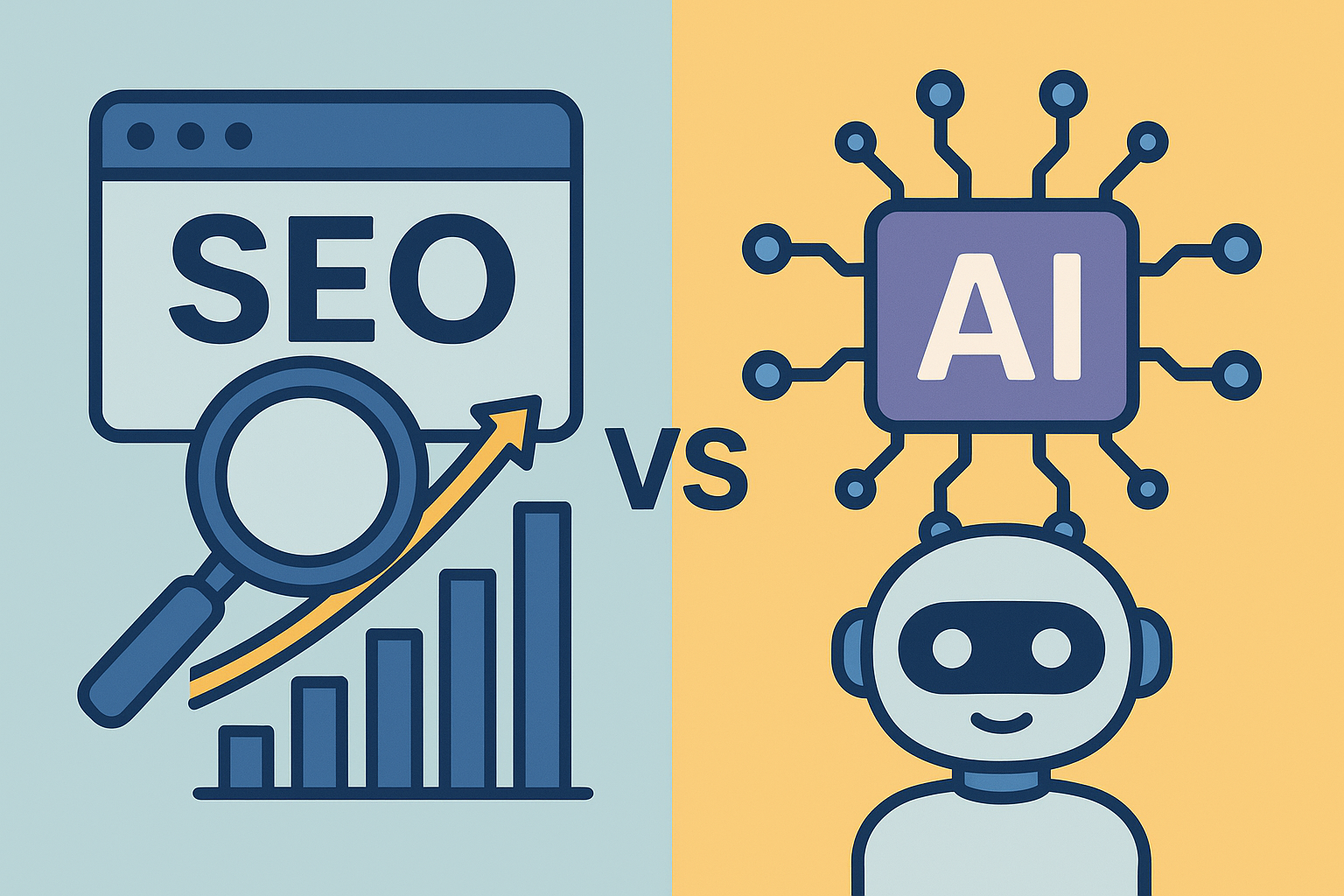
Traditional SEO vs AI SEO: Key Differences and How to Future-Proof Your Content
Traditional SEO and AI SEO have become some of the most talked-about topics in content marketing today. As a marketer, it’s natural to wonder what these changes mean for your work and whether you need to rethink your entire strategy.
The truth? Search has certainly evolved, but not as drastically as some make it seem. What’s happening is a shift in how content is discovered and processed.
In this article, we’ll break down the key differences between traditional SEO and AI SEO, explore how each works, and show you how to adapt your strategy to stay visible in both search engines and AI-generated results.
What Is Traditional SEO?
Traditional SEO (Search Engine Optimization) is the process of improving your website’s visibility on search engines like Google and Bing. It’s what most marketers have been doing for years. It involves researching keywords, creating high-quality, SEO-friendly content, earning backlinks, and optimizing on-page elements like meta tags and headings to rank higher in search results.
The goal is simple: when someone types a query into Google, you want your content to appear as one of the top results.
What Is AI SEO?
If traditional SEO is about making your content easy for Google and humans to find and understand, AI SEO is about making your content easy for AI to find, understand, and trust.
AI SEO focuses on ensuring that AI-powered search tools like Google AI Mode, ChatGPT Search, or Perplexity can accurately process, summarize, and even cite your content. It is also called generative engine optimization.
If a human reader skims your content and says, “Yep, this makes sense,” an AI should be able to do the same, and confidently reference it when generating answers for users. This means content must be:
- Factually accurate: AI tools are designed to reward trustworthy information. Misinformation or inconsistencies can hurt your chances of being cited.
- Structured and clear: Using headings, bullet points, and schema markup helps AI parse your content efficiently.
- Topically authoritative: Cover your subject thoroughly, showing expertise and depth so AI recognizes your content as a reliable source.
- Consistent: Maintain accuracy and quality across your site; AI systems favor sources that demonstrate trustworthiness over time.
In short, AI SEO is traditional SEO on steroids, with an extra focus on readability and value for machines as well as humans.
Has Marketing Really Changed with AI SEO?
In truth, not as drastically as it might seem.
AI search tools like ChatGPT, Perplexity, and Google’s AI Overviews have changed how users discover information. People are getting answers directly from generative models instead of clicking through traditional search results. But the foundation of good SEO, like clarity, accuracy, and relevance, still holds strong.
You don’t need to throw out your old SEO playbook. You just need to adapt it. Optimizing for AI search engines means writing content that’s factually sound, context-rich, and clearly structured, so AI can easily interpret and cite it in responses.
For example, AI tools tend to pull snippets that answer a question directly and concisely. So, adding short, well-formatted explanations or summaries within your content helps you rank in both Google and AI-generated answers.
In other words, AI SEO isn’t replacing traditional SEO. The same strategies that made your content valuable to search engines now make it easier for AI systems to understand and use.
Key Differences Between Traditional SEO and AI SEO
Traditional SEO and AI SEO share the same goal, helping your content get discovered, but they approach it differently. Traditional SEO is all about optimizing for search engines, while AI SEO focuses on optimizing for AI-driven experiences, like Google’s AI Overviews, Perplexity, or ChatGPT responses.
Here’s a closer look at how they differ:
1. Discovery Model
In traditional SEO, users type a query into Google and manually click through links. AI SEO changes that process. Instead of presenting a list of blue links, generative search tools summarize answers directly, pulling from multiple sources. This means visibility now depends on how well your content can be understood and referenced by AI models, not just ranked by an algorithm.
2. Optimization Focus
Traditional SEO revolves around keywords, backlinks, and metadata. AI SEO, on the other hand, focuses on context, structure, and clarity. AI models look for well-organized, factually consistent information they can easily interpret and use in responses. So, while traditional SEO asks “How do I rank?”, AI SEO asks “How can AI understand and cite my content accurately?”
3. Metrics and Success Measurement
SEO success is measured through metrics like traffic, rankings, and click-through rates. But with AI SEO, it’s about mentions and visibility in AI-generated responses. You might not get a direct link or click, but if your brand is frequently referenced by AI tools like Perplexity or ChatGPT, that’s a form of digital authority too.
4. User Experience
Traditional SEO delivers results through links and articles. AI SEO delivers answers. The user experience is more conversational and direct, meaning your content must be written in a way that AI systems can extract, summarize, and present easily, without losing accuracy or context.
In summary, traditional SEO helps people find your content, while AI SEO helps AI engines understand and use your content. The smartest marketers aren’t choosing one over the other. Instead, they’re combining both to stay visible across every search experience.
Here’s a table summarizing these key differences:
| Focus Area | Traditional SEO | AI SEO |
|---|---|---|
| Visibility | Search engine rankings (Google, Bing, etc.) | Inclusion in AI-generated summaries, answers, and citations |
| Keywords | Optimizing for specific keywords and phrases | Emphasizing context, entities, and semantic relationships |
| Trust | Building backlinks and domain authority | Establishing factual accuracy, topical authority, and trust signals |
| Engagement | Click-through rates (CTR) and user behavior | AI recognition, summarization, and reference in knowledge panels |
| Audience | Humans | Humans and AI systems |
Let’s break it down with an example:
Imagine you run a recipe blog. Traditional SEO would focus on keyword-rich titles like “Easy Chocolate Cake Recipe,” earning backlinks from other food blogs, and optimizing meta descriptions to boost CTR.
AI SEO, on the other hand, would ensure your recipe is clearly structured, factually accurate, and uses standardized formats like schema markup. This way, AI tools can summarize your recipe correctly and even recommend it to users searching for “best chocolate cake recipe for beginners” in their AI-powered answers.
In short, traditional SEO gets humans to your content, while AI SEO ensures AI recognizes, trusts, and cites your content.
Pro Tip: The best strategy isn’t choosing one over the other. Combining both ensures your content ranks on Google and gets referenced by AI tools.
How to Adapt Your SEO Strategy for the AI Era
You don’t need to throw away everything you know about SEO. You just need to refine it. The goal is to make your content not only discoverable by search engines but also understandable, quotable, and useful for AI models. Here’s how to do it:
1. Prioritize clarity and structure
AI systems like Google’s SGE, ChatGPT, and Perplexity parse and summarize your content based on how well they can detect structure, authority, and contextual clarity. If you want your content to surface in AI-generated answers, you have to write for machines that think like humans, but read like robots.
Here’s how to actually do that:
- Front-load key takeaways: Don’t bury insights halfway through your section. AI summarizers often pull sentences from the first 20–30% of a paragraph. For instance, instead of saying “Another thing to note is that keyword clusters…”, start with “Keyword clustering improves topical depth because…”
- Build semantic consistency: AI tools map meaning through related terms. Use topic clusters, synonyms, and entity mentions. If your topic is “AI SEO,” weave in phrases like “search generative experience,” “AI-generated answers,” and “content summarization.” This strengthens your semantic graph.
- Structure data-rich answers: Use formats AI can extract easily. Some examples are comparison tables, numbered strategies, or “X vs Y” breakdowns. For example, a mini-table comparing “Traditional SEO vs AI SEO” (with columns for ranking factors, tools, and goals) can be pulled almost word-for-word into AI answers.
- Use precision-friendly language: AI prefers sentences that can stand alone without context. Write self-contained sentences like “AI SEO focuses on optimizing for machine summarization and answer generation, not just ranking in SERPs.” Avoid vague connectors like “it,” “this,” or “that” without clear subjects.
- Tag your content meaningfully: Use schema markup beyond basics. Add HowTo, FAQ, and even Article or Speakable schema where relevant. It helps AI identify what format your content fits.
- Summarize with intent: End every major section with a one-line insight that starts with phrases like “In short,” “The key takeaway,” or “Bottom line:” These are linguistic cues AI models are trained to recognize for summarization.
2. Write Short, Factual Answers Right Under Each Heading
When optimizing content for AI SEO, the first few lines after your headings are crucial. AI summarizers often grab the first 2–3 lines under an H2 or H3 to create summaries, snippets, or answers. This means the way you start each section can directly impact whether your content gets cited.
Here’s how to do it right:
- Avoid starting with a story, anecdote, or long context. AI may skip over the key information if it’s buried in a paragraph.
- Start with a concise, one-sentence answer. Get straight to the point so AI immediately “understands” the main idea.
- Then expand with supporting details, examples, or explanations. Once the AI recognizes the answer, it can pull additional context from the rest of the section.
Here’s an example:
Bad:
“When I first started learning SEO, I struggled to understand the difference between keywords and search intent. But over time, I realized that…”
Good:
“Keywords are specific words or phrases users type into search engines. They help AI and humans understand the topic of your content. Using relevant keywords in your headings, subheadings, and body text improves both visibility and trustworthiness.”
Pro Tip: Think of it like answering a question in a FAQ. The AI sees the heading as the question, so your first line should be the direct answer, followed by elaboration.
3. Write with intent: answer questions completely
Instead of keyword stuffing, focus on providing direct, well-rounded answers to user queries. If someone searches “how to scale SaaS without technical debt,” your content should immediately walk them through causes, risks, and practical steps, not just mention the phrase a few times. The more context and completeness your answer has, the more valuable it becomes for both Google and AI engines.
4. Optimize for both search engines and AI tools
Traditional SEO techniques, like keyword optimization, internal linking, and backlinks, still matter. But now, you should also think about how AI interprets your content semantically. Use natural language, define terms clearly, and add factual data where possible. AI models value sources that are accurate, structured, and context-rich.
5. Create content for humans, not algorithms
AI-driven search rewards content that feels genuinely helpful. Use a conversational tone, avoid jargon where possible, and focus on clarity. If a human finds your content easy to understand and engaging, an AI model likely will too. The goal is to make your content human-readable and machine-recognizable.
6. Track your mentions in AI-generated results
Just as you track your Google rankings, start monitoring how AI tools reference your brand. Platforms like Nightwatch can help you identify when your content is cited or summarized in AI responses. This helps you see which pieces perform well in generative searches and which might need better clarity or authority signals.
Future-Proof Your SEO Strategy: Combining Traditional and AI SEO
Even with all the debates flying about, traditional SEO remains essential for building search rankings, domain authority, and organic traffic. AI SEO complements that structure by ensuring your content is discoverable, understandable, and cited by AI-powered search tools. By optimizing for both humans and AI, you create content that ranks on Google and appears in AI-generated answers, summaries, and knowledge panels.
To succeed, focus on factual accuracy, structured data, clear headings, and topical authority. These elements help your content stand out to both search engines and AI systems, giving you a competitive edge.
Want to see how your content performs in traditional search and AI-driven results? Nightwatch provides advanced rank tracking, SEO analytics, and AI-friendly insights to help you monitor your visibility, spot opportunities, and optimize your content for maximum reach. Start tracking with Nightwatch today!