5 Best Local Rank Tracking Tools for Marketers in 2026
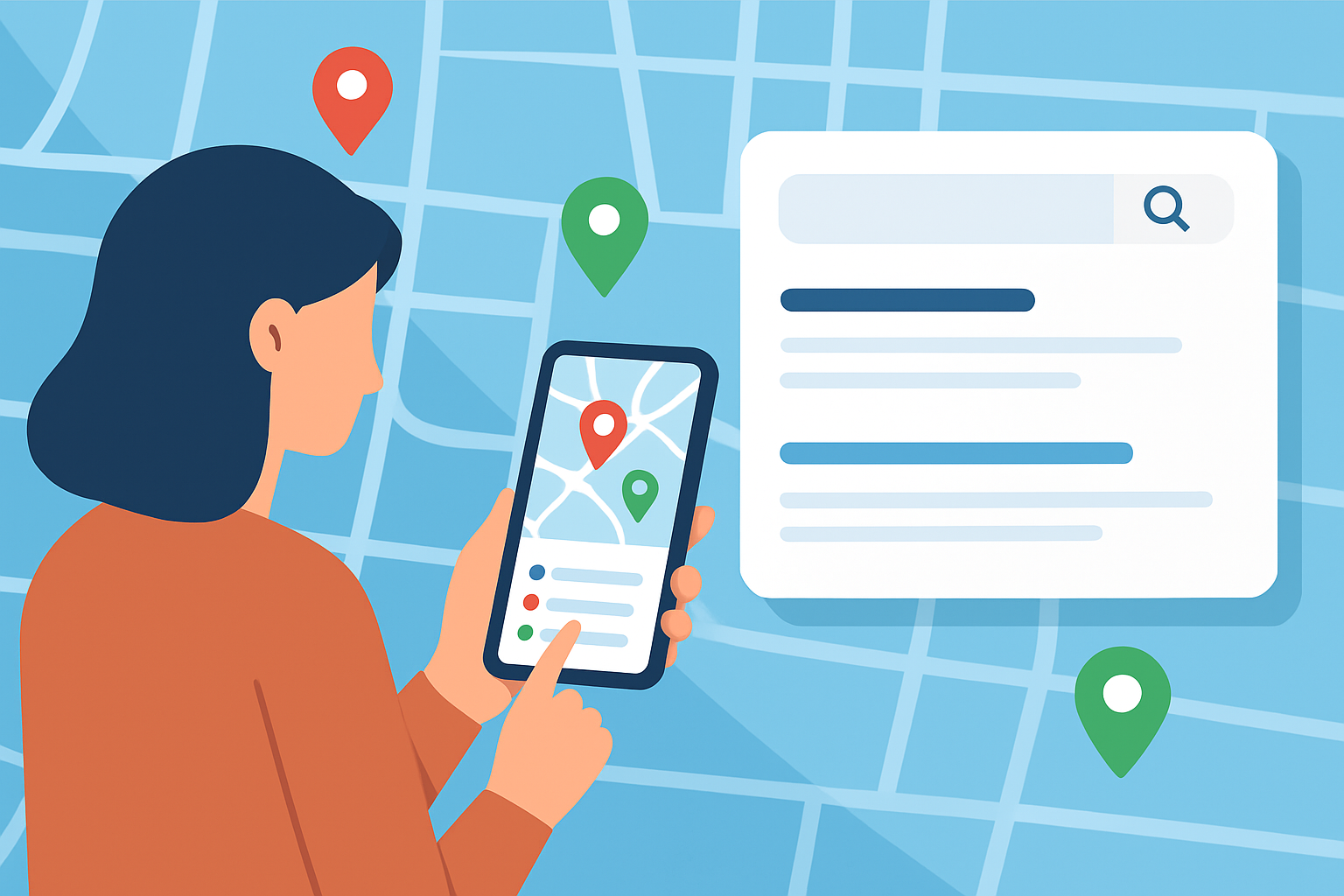
When someone pulls out their phone and searches “best pizza near me” or “emergency plumber,” where you appear on Google Maps literally decides whether they’re clicking your listing or moving on to the next one. And the numbers don’t lie: 46% of all Google Searches have local intent, and 76% of people who search for something nearby visit a business within 24 hours.
That’s opportunity slipping away if you’re not visible.
But tracking where you actually rank isn’t as simple as just looking up your store on Google. You need to know your position across different neighborhoods, understand how your Google Business Profile is doing, and keep tabs on the competition. Your basic rank tracker can’t handle all that.
So we did the legwork. We tested the market and found the best local rank tracking tools that actually work. These tools can help you dominate local search, stay visible in the right places, and convert those searches into paying customers. Take a look.
What Are Local Rank Tracking Tools?
Local rank tracking tools are specialized SEO software that monitor where your business shows up in location-specific search results. Unlike traditional rank trackers that show nationwide positions, local rank trackers reveal exactly where you appear when someone searches from specific GPS coordinates or service areas.
Here’s what they track:
- Your organic results in local search
- Local Pack rankings (that crucial map-based 3-pack at the top of Google Search Results)
- Where you stand on Google Maps
- Your Google Business Profile’s visibility across different locations
- Even Apple Maps rankings for iOS users
The key differentiator here is geo-grid technology. Instead of checking rankings from a single location, these tools track your visibility across a custom geo-grid that covers your entire service area. This location-specific data shows exactly where potential customers can find you, by highlighting the areas where you’re performing strongly and the spots where you’re virtually invisible. For developers building custom local SEO solutions, a SERP API provides granular location-based search data programmatically.
Why You Need a Local Rank Checker Tool
Local search isn’t one-size-fits-all. Your rankings shift depending on where a customer is searching from, so standard SEO tools and rank trackers can’t tell you the full story. A local rank checker is specifically built for this, as it shows exactly where you’re visible and where you’re missing out. If you run a business, here are the specific reasons why you should invest in one.
Monitor Hyperlocal Search Performance
Local rankings jump around based on GPS coordinates. A searcher three blocks away might see you at number one, while someone five blocks away doesn’t see you at all. A local rank checker and tracker tool gives you accurate position tracking across your entire service area, showing exactly where you’re visible and where you’re bleeding opportunities. This detailed insight into local keyword rankings tells you which neighborhoods need attention and which marketing activities are actually working.
Dominate the Local Pack
The Local Pack consists of three businesses, each with a map pin at the top of local search results, which capture the lion’s share of customer engagement. Studies prove 44% of clicks go to Local Pack listings. That’s nearly half of all potential customers. Local rank trackers monitor your position in this high-stakes real estate across different locations, helping you optimize your Google Business Profile and local SEO strategy to capture those valuable clicks.
Track Multi-Location Performance
If you run multiple locations or cover several service areas, multi-location tracking capabilities can help you monitor each location individually, compare ranking data across territories, and spot which locations need help. This is essential for franchises and service businesses covering multiple cities, or any company with physical locations in different markets.
Gain Competitive Intelligence
Local rank trackers reveal your competitors’ visibility heatmaps, their Google Business Profiles performance, and their keyword rankings in different neighborhoods. This intelligence shapes your marketing plan and helps you identify underserved areas where you can steal market share.
Measure Business Visibility and ROI
Local rank tracking tools connect search rankings to actual business outcomes by integrating with Google Analytics, Google Search Console, and Looker Studio. These features help you track how improvements in local rankings correlate with organic traffic performance, customer reviews, phone calls, and directions requests, so you can prove the ROI of your local SEO investments to stakeholders.
Adapt to Evolving Search Patterns
AI search engines and AI assistants like ChatGPT are reshaping how people discover local businesses. Modern rank trackers help you monitor visibility in these emerging platforms alongside traditional Google search engine results. Stay ahead of the curve as search behavior changes instead of scrambling to catch up later.
Make Data-Driven Optimization Decisions
Without accurate ranking data, local SEO is mostly guesswork. Local rank tracking shows how your business actually appears in search results, helps you improve your content with the right keywords, and guides updates to your Google Business Profile. It also helps you make smarter choices about schema markup, content, and even customer service.
Essential Features to Look for in Local Rank Tracking Software
Not all local SEO tools deliver the same value. The right local rank tracker provides precision tracking, comprehensive data, and actionable insights that actually improve your local search rankings.
- Geographic Precision: Look for custom geo-grid tracking with GPS coordinates-based accuracy. The best tools offer visual map displays, a heatmap tool visualization showing where you’re visible, pin tracking for monitoring specific locations, and an adjustable map size to perfectly match your service areas.
- Comprehensive Data and Reporting: Effective tools track keyword rankings across organic results, Local Pack, and Google Maps separately, because your position varies across these placements. They monitor SERP features, provide search volume trends showing what people actually search for, and integrate seamlessly with Google Search Console and Google Analytics.
- Competitive Analysis: The right local rank checker should help you track your market position using Share of Voice metrics and compare your rankings with competitors to identify where you’re performing well and where you’re falling behind. You should also be able to monitor business and client reviews for both your company and competitors, since review quantity and quality directly influence local search rankings.
- Technical SEO Tools: The best platforms include site audit capabilities for catching technical issues, NAP (Name, Address, Phone) consistency checking across the web, structured data and schema markup validation, backlink checker functionality, and keyword research tools for keyword prospecting that uncovers new opportunities.
5 Best Local Rank Tracking Tools for 2026
After extensive testing, these five tools stand out for accuracy, features, and actual value in tracking local search rankings.
1. Nightwatch
I’ve spent way too much time staring at spreadsheets full of ranking data, trying to figure out what’s actually happening with local visibility. Numbers in rows and columns don’t tell you much when you’re managing dozens of locations or tracking rankings across different neighborhoods. Nightwatch fixes that problem by turning complex ranking data into visual maps and heatmaps that you can actually understand at a glance.
Visual Rank Tracking That Makes Sense
What sets Nightwatch apart is how it presents local ranking data. The platform’s geo-grid tracking monitors your rankings from up to 100 GPS coordinates simultaneously, and instead of giving you a giant table of numbers, it displays everything as a visual grid. You can see exactly where you’re ranking strong, where you’re weak, and where you’re completely invisible, all color-coded so patterns jump out immediately.
The tracking itself is comprehensive. It covers your positions in organic results, the Local Pack, and Google Maps, which are the three main surfaces where local businesses appear in search. You need visibility into all three because performance varies. You might dominate Maps but be invisible in the Local Pack, or rank well organically but not show up on Maps at all.
Multi-Location Management Without the Chaos
If you’re managing SEO for multiple locations, Nightwatch handles that complexity elegantly. Each location gets its own geo-grid, but you also get consolidated dashboards that roll everything up. You can zoom out to see how your entire operation is performing, or dive into individual locations to troubleshoot specific problems.
Integrations That Pull Everything Together
What really makes Nightwatch powerful is how it integrates with the tools you’re already using. Connect Google Search Console, Google Analytics, and Looker Studio, and suddenly you’ve got comprehensive local SEO dashboards with all your data in one place. Metrics such as rankings, traffic, conversions, and technical issues live together in one platform instead of being scattered across multiple tools.
Additional SEO Tools
Beyond rank tracking, Nightwatch offers an SEO AI agent, site audits, backlink checking, and keyword research tools, all optimized for local search.
- The SEO AI agent is especially useful to physical businesses as it delivers actionable recommendations for improving local rankings. All you need to do is prompt it as you do ChatGPT.
- Site audits uncover technical issues like missing schema markup, broken citations, slow page speed, or mobile usability problems.
- The backlink checker shows which local sites link to you and highlights opportunities to build more local authority.
- Keyword research tools help you find untapped local search terms, including long-tail variations and “near me” queries.
Having all these features in one platform means you’re not juggling five different tools just to manage local SEO. Everything you need, such as tracking, auditing, research, and reporting, lives in one place.
Pricing: Starts at $32 per month with a 14-day free trial.
Pros
- Intuitive heatmap tool with stunning visual displays that make sense immediately
- Highly accurate geo-grid technology with customizable density
- Comprehensive integration with Google tools you already use
- Excellent white-label reports that make you look good to clients
- Multi-location tracking with both consolidated and individual reporting
Cons
- Initial geo-grid setup has a learning curve
Best for: Agencies and businesses needing comprehensive local rank tracking with white-label reporting.
2. AccuRanker
I’ve used a lot of rank tracking tools over the years, and the one thing that always frustrated me was waiting. You make changes to a page, publish it, and then… nothing. You sit there refreshing dashboards that won’t update for hours or sometimes days. AccuRanker fixes that problem, and honestly, that’s the main reason it’s stuck around in my workflow.
AccuRanker is built for speed. You get daily automatic ranking updates from whatever location you set (down to GPS coordinates if you need that level of precision), but the real advantage is on-demand tracking. You can manually refresh rankings whenever you want and see results in seconds, not hours.
That matters more than it sounds like. If you’re running technical SEO checks, tweaking title tags, or adjusting content based on competitor analysis, you need to know if your changes are working now, not tomorrow morning when some tool finally gets around to crawling the SERPs again. AccuRanker lets you check immediately, which means you can iterate faster and stop second-guessing whether your optimizations actually moved the needle.
The SERP tracking goes deeper than basic position monitoring. It tracks over 50 SERP features, including Local Pack positions, knowledge panels, featured snippets, and your Google Business Profile rankings. This gives you a complete picture of how you’re showing up in search results.
Pricing: Starts at $249 per month with annual discounts.
Pros
- Fastest data updates with on-demand refresh capability
- Tracks 50+ SERP features including Local Pack
- Highly accurate GPS coordinates-based tracking
- Advanced segmentation for slicing data however you need
- Excellent API for custom integrations
Cons
- Premium pricing puts it out of reach for small businesses
- Less visual than competitors’ heatmap tools
- Setup requires more technical knowledge
- Limited site audit capabilities
- No built-in geographic heatmap visualization
Best for: Enterprises and agencies
3. BrightLocal
BrightLocal is a full local SEO suite that handles everything you need to manage local visibility for clients. This local SERP tracker gives you detailed ranking grids with customizable pin tracking, so you can see exactly how a business ranks across different neighborhoods or regions. That level of granularity matters when you’re optimizing for “plumber in Brooklyn” versus “plumber in Manhattan.”
But the real value is everything else BrightLocal includes. NAP consistency monitoring ensures your business name, address, and phone number match across every directory and citation, which is critical for local rankings since Google uses this data to verify legitimacy. Citation management tracks where your business is listed and flags inconsistencies or missing listings. Review monitoring pulls in customer feedback from Google, Facebook, Yelp, and other platforms, complete with sentiment analysis so you can spot trends without reading hundreds of reviews manually.
Finally, there’s the inbuilt competitor analysis tool, which lets you benchmark your local visibility against competitors in the same area. You can see where they’re getting citations, how their reviews compare to yours, and which keywords they’re ranking for that you’re missing.
Pricing: Starts at $49 per month for a single location. Multi-location plans scale with locations and features needed.
Pros
- Exceptional multi-location tracking perfect for franchises
- Industry-leading white-label reports
- Robust reputation and review management built in
- NAP consistency and citation management included
Cons
- Interface can feel cluttered with so many features
- Pricing climbs quickly with multiple locations
- Geo-grid visualization less intuitive than dedicated heatmap tools
- Learning curve for mastering all features
- Some feature overlap with tools you might already use
Best for: Agencies managing comprehensive local SEO campaigns and franchises needing all-in-one management.
4. Localo
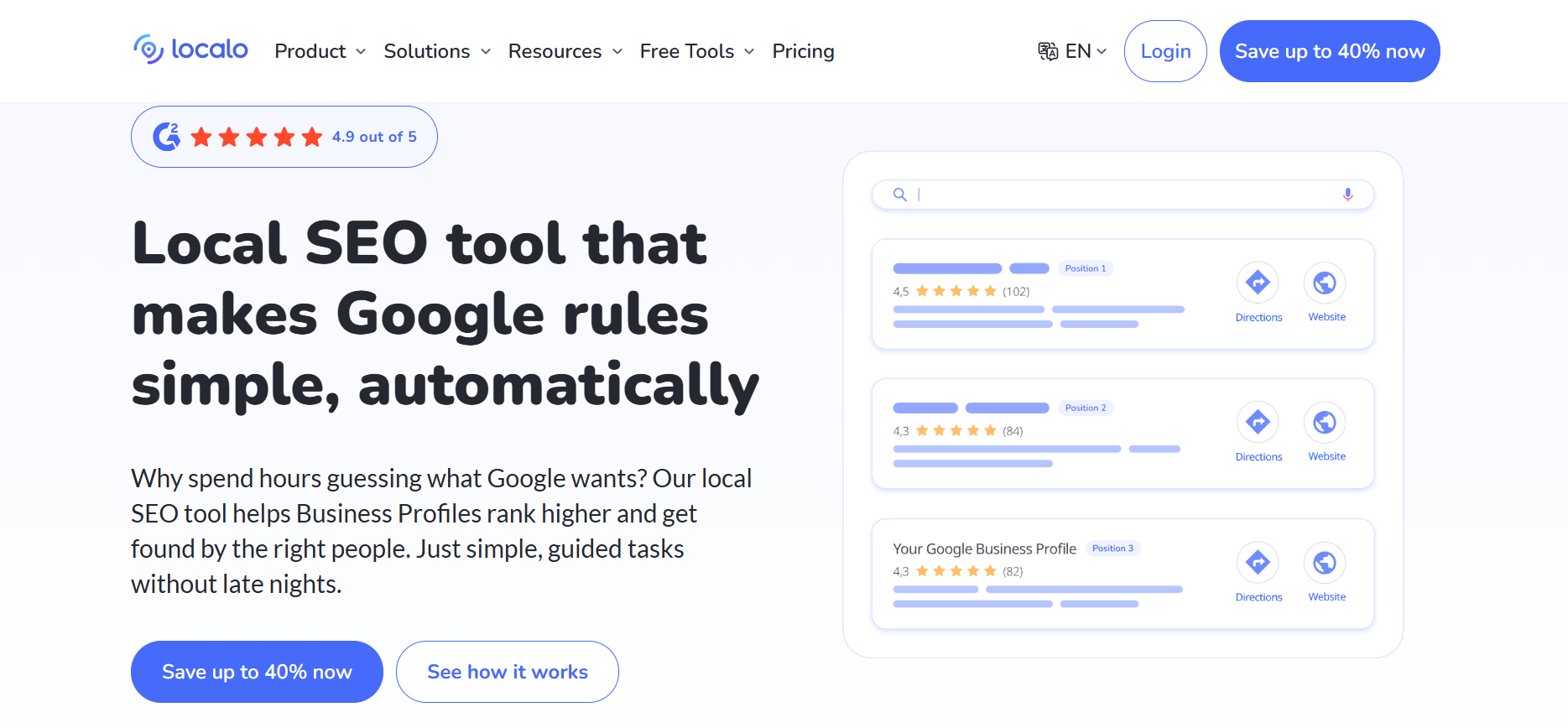
If you’ve ever tried explaining local SEO performance to a client using spreadsheets and numbers, you know how their eyes glaze over. Rankings by ZIP code, position tracking across neighborhoods, and visibility in different service areas are all important, but also incredibly dry when presented as raw data. Localo solves this by turning local rank tracking into something visual and immediately understandable.
It’s built on DAXRM’s Local Rank Tracker technology and focuses specifically on making local visibility easy to see and communicate, through gorgeous visibility heatmaps. Instead of showing you a list of rankings by location, it displays everything as color-coded grids overlaid on a map of your service area. Green means you’re ranking well. Red means you’re invisible. Everything in between shows exactly where you stand.
This visual approach matters more than it sounds like. You can see at a glance which areas need work, which competitors are dominating specific neighborhoods, and where your SEO efforts are actually paying off. For client reporting, this is gold. Instead of presenting tables of keyword positions, you show them a visual map where they can literally see their business getting more visible over time.
Pricing: Starts at $27 per month for a single business profile. Multiple businesses come with higher plans.
Pros
- Best-in-class heatmap tool with intuitive visuals anyone can understand
- Gorgeous grids make complex data immediately clear
- Flexible custom geo-grid tracking
- Pin tracking for monitoring specific important locations
- Visual competitor analysis overlays on the same grid
Cons
- Fewer additional SEO tools than comprehensive platforms
- Limited SERP features tracking beyond basic Local Pack
- Less extensive integrations than enterprise tools
- Reporting leans heavily on visuals versus data tables
- Email-only customer service without phone support
Best for: Businesses needing to quickly understand and communicate local visibility across service areas to stakeholders.
5. Keyword.com
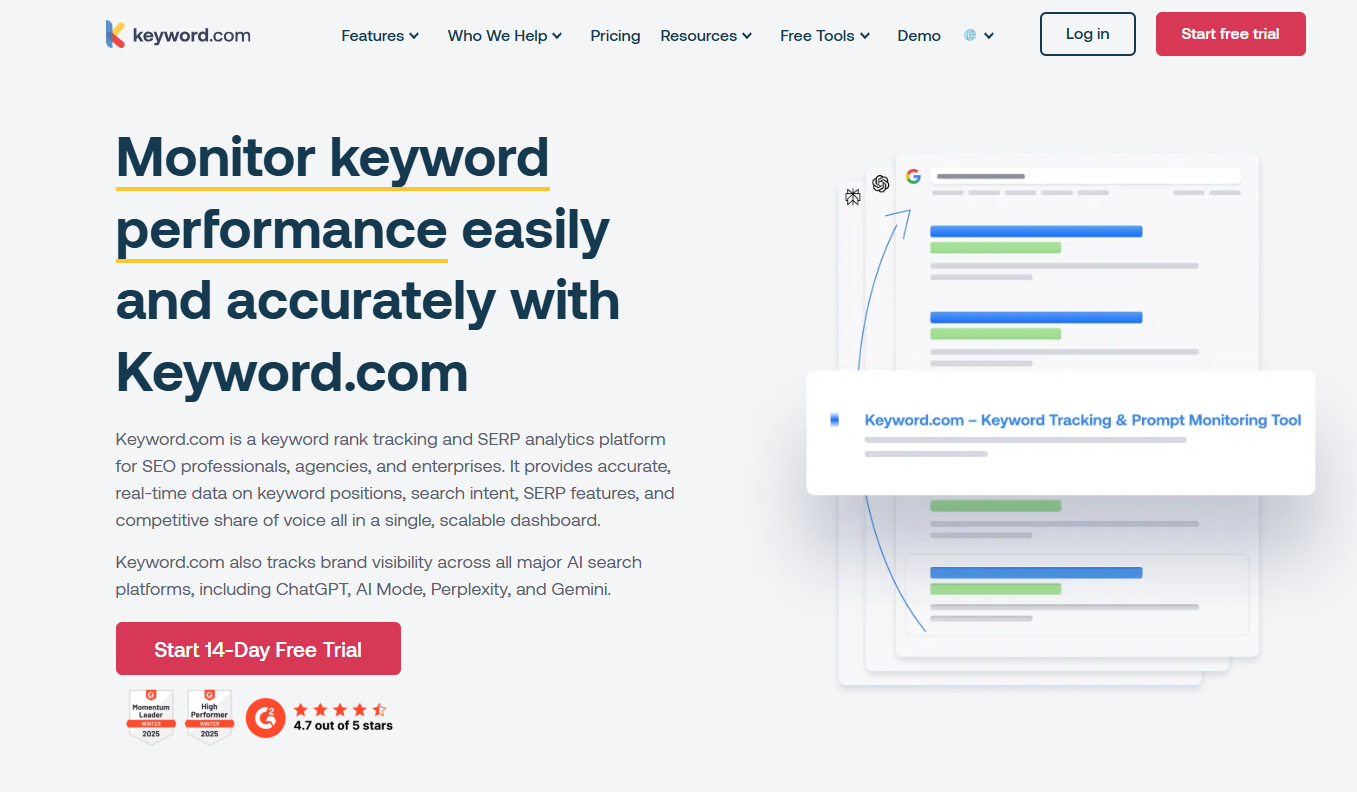
Keyword.com delivers solid local rank tracking at a price that doesn’t require CFO approval, making advanced SEO tools accessible for small businesses and solo consultants. The interface might not be flashy, but the location-specific rank data is accurate and reliable.
You can see how your business performs in organic results, Local Pack, and Google Maps, and historical data lets you track trends over time. Multi-location support helps if you have several locations, and local ranking grids turn geographic visibility into an easy-to-read map, complete with adjustable map sizes and pin tracking for your most important spots.
As the rank checker is merely a sub-feature within a much larger SEO suite, a subscription here also buys you keyword research and prospecting tools to uncover money keywords and hidden opportunities in your market. Search volume trends help you decide which terms are worth prioritizing, while competitor tracking and share of voice metrics reveal where you’re winning, and where you’re being outpaced.
Overall, Keyword.com makes local SEO actionable without making it complicated or expensive. It gives you reliable data, meaningful insights, and the tools to turn local rankings into real business growth, even if you’re a one-person team.
Pricing: Starts at $16 per month with a 14-day free trial.
Pros
- Affordable professional local rank tracking option
- Accurate GPS coordinates-based tracking
- Includes keyword research and prospecting for local terms
- Basic site audit and technical SEO checking
- Transparent pricing with free trial
Cons
- Visual interface less sophisticated than premium alternatives
- Limited heatmap tool capabilities for geographic visualization
Best for: Small businesses and startups needing accurate local rank tracking without enterprise costs.
Frequently Asked Questions
What’s the difference between local and regular rank tracking?
Regular rank tracking shows average rankings without caring where people actually search from. Local rank tracking uses GPS coordinates to show exactly where you rank from different locations throughout your service area. Local trackers also monitor Local Pack position and Google Maps rankings, which are critical placements that don’t even exist in traditional organic results.
How accurate are local rank tracking tools?
Modern tools using GPS coordinates-based tracking are highly accurate, typically within 1-2 positions of what real searchers see. Accuracy depends on geo-grid technology precision, how often they update, and their tracking method. Tools with daily ranking scans provide more accurate trending data than weekly updates that miss important shifts.
Keep in mind: local search results can vary slightly based on search history and user signals even from the same location. Rank trackers typically show “clean” results without personalization, which might differ slightly from individual searcher experiences. But for making optimization decisions and measuring progress, the accuracy is more than sufficient.
Can I track rankings for multiple business locations?
Absolutely. All major tools offer multi-location tracking, though sophistication varies wildly. You can track each location separately with its own custom geo-grid, keywords, and competitors. Advanced platforms like Nightwatch excel at multi-location tracking, providing individual visibility heatmaps for each location with reporting showing performance across all locations.
How often should I check my local rankings?
Weekly ranking scans hit the sweet spot for routine monitoring. Daily fluctuations are normal and don’t necessarily signal real problems. But here are situations you should pay attention to: during active campaigns (check daily to assess impact quickly), after major website changes or Google Business Profile updates (monitor daily for 1-2 weeks to catch issues early), and in highly competitive markets (more frequent tracking helps you respond faster to competitor moves).
Found the Right Local Rank Checker Yet?
Local SEO is about understanding exactly where your business appears in search results and taking steps to improve visibility. Start by tracking your rankings across all key locations, monitoring both broad and long-tail keywords, and keeping an eye on competitor performance. Pay attention to your Google Business Profile and customer reviews, making sure your information is consistent and accurate across directories. Use insights from your data to adjust your content, optimize keywords, and target neighborhoods where you’re underperforming.
If you haven’t chosen a local rank checker yet, Nightwatch is a reliable option that makes tracking your rankings, analyzing competitors, and uncovering local SEO opportunities simple.
Try it for free today and see exactly where your business stands and where you can grow.